happy Canada day!

Me, Joe & Mom – a whole lot of years ago

This is a relatively young country.

This is a remarkably diverse country.

This country moves forward, becomes fairer and kinder, one relationship at a time, one interaction between fellow Canadians at a time.

Assume the best intentions in others. Don’t assume you own the whole truth. Listen, argue reasonably, look for compromises whenever possible. Be honest brokers of facts. No one holds a monopoly in bigotry or purity. Humans are complex, expect contradictions, be patient.

Don’t be misled by idealogues. Don’t be defined by rigid labels. Don’t be cowered by authoritarians.

Trump defines America as this point in their history. Trump does not define us. We define us. Stay focused on that.

I’m proud to be Canadian, this work-in-progress country, this vast, beautiful country, this country that is the sum of the world.

Happy Birthday fellow Canadians!

Not your typical dragon – the musical!

When a book is published, it goes out into the world and then an author waits to see how it is received and what kind of life it will have. Not Your Typical Dragon has had a pretty good life since is was first published in 2013. Sometimes I just watch it from afar, like a parent getting a letter from their child that gives a report of their latest accomplishments.

Just these past few months, Not Your Typical Dragon was adapted into a musical that was performed last week at the Erie Playhouse in Erie, Pennsylvania. There were eight performances in front of an audience of over 3,000 children. The tickets had been made free, so that children of all economic backgrounds would have the opportunity to experience a live performance. The production was put together under the talented and creative guidance of the coordinator, Trish Yates.

All that was required of me was to give my blessing and to record a short video greeting that they showed at the start of each play. Living on the other side of the continent in Vancouver, in Canada, I unfortunately couldn’t attend, but how I wish I could, judging by the photos and the recordings of the musical numbers that Trish sent me over the weeks! As you can see, it was quite the production, and made interactive with the audience as well, using a giant Crispin head that children could go inside to project all the silly things that Crispin breathes out instead of fire.

At the end of the show, children received buttons and copies of the book that were made available by Dolly Parton’s Imagination Library, who had already included my picture book into its collection for several years in the past.

Sky Train

At age five I would create city tableaus atop my dresser. Alphabet blocks were stacked precariously into office towers (I was not a well-coordinated child), pencils anchored in blobs of plasticine served as streetlamps, and my Hot Wheel car collection created the gridlock that ran the city’s length. Assorted plastic animals – elephants, giraffes and tigers –roamed freely within my utopia, which might have played a part in the traffic jam.

When I was six I asked for a Kenner’s Girder and Panel construction set for my birthday because in a commercial wedged between the Saturday morning cartoons, they promised I could create a realistic modern office tower cityscape with cars zipping in between the buildings on raised highways. Even in black and white television, I was sold. The buildings one could make were truly Modern, in the style of Ludwig Mies van der Rohe’s 1967-69 Toronto Dominion towers. Armed with travel experience I didn’t have at age six, I realize now that the commercial’s vision of elevated transportation was more akin to Tokyo than my hometown Edmonton, Alberta. But in any case, the actual results were underwhelming. I even wondered if I had bought the wrong construction set.

Now I live in Vancouver, and it occurred to me the other day that I’ve been living inside that urban fantasyland I dreamed of as a kid. Most of the track that our city’s unmanned trains whiz along are outside and held aloft on cement columns. Riding the Skytrain, the landscapes you pass through are varied. There are industrial and light industrial areas, there are suburbs of detached homes close enough to snoop into backyards, there’s one trailer park and one RV park that I’ve spotted. Shopping districts go without saying, but there are also vistas across the Fraser River, showing pulp mills and farmland and mountains in the distance. And of course, with each new Skytrain line added, the new stations become magnets for high-rise development. There are many sections in which a trip will take you through a canyon of condos just like those long-ago commercials promised me. It’s as futuristic an experience while on the train as it is looking up from the ground and seeing these people-movers pass across your line of sight.

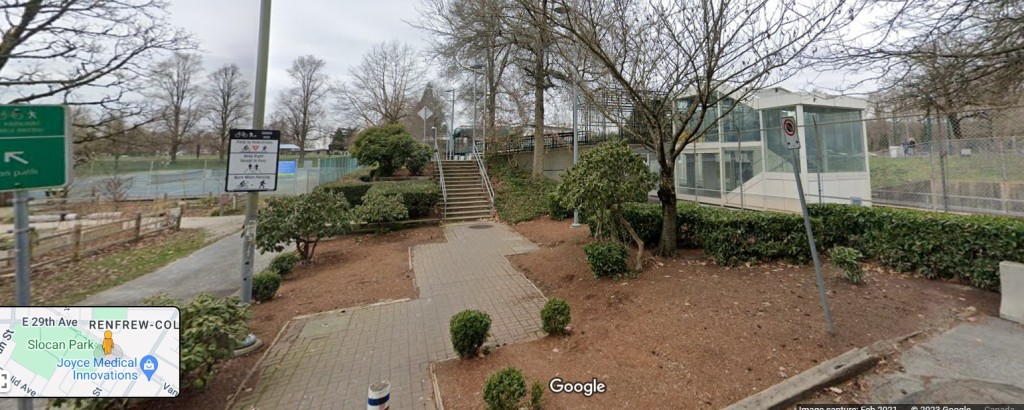
One of my favorite stations is called 29th Avenue. It’s part of the original Expo Line which was built when Vancouver hosted Expo 86 and was forever changed from sleepy, small-town city to whatever it is now, which depends on who you ask. This station is not raised like most, but is actually semi-submerged. Slocan Park runs along the south side which gives you the impression of this transportation-of-the-future stopping in the middle of nature and quiet rural life just as the interurban trams did at the end of the 19th century.

https://www.youtube.com/watch?v=MCYO6JFANg0

You can find online, restored and colourized films of streetcar trips along big city streets as seen from the driver’s POV. Because the Skytrain is operated from a central command centre, a single driver’s seat is always available at the front and back of a train. Children rush for them, but so do many adults. The fancy to shrink down to model train size is apparently not only mine.

I abandoned driving when I moved here thirty years ago, for different reasons. Our city planners assume that all of us will merrily replace our cars with bikes, but Vancouver is hilly and yes, even mountainous, and not all of us are up to that challenge. I mostly rely on public transportation. The bus system is a much more onerous option, slow and crowded due to an increasing population and roads that are narrow with no room to expand. But the Skytrain makes many areas effortlessly accessible and I eagerly await the construction of every new line. As a walker, having quick access to other parts of city means I can explore what would otherwise have been ignored. Find the hidden curiosities that are made more poignant by having been stumbled across.

I wish there were Skytrain lines that covered the whole Lower Mainland (as this region is referred to). More to the point, I wish there were Skytrain lines across the globe, zipping here and there, connecting my neighbourhood to a million others. There is so much of the world I still want to see, so many neighbourhoods I’d like to walk through. It’s only through close proximity that we can appreciate the marvelous paradox of how similar we all are and yet how uniquely different. Yes, I know that’s trite. But another paradox I find is that as our planet gets warmer, we are all growing colder.  Earth hasn’t changed in size, as far as I know, yet we couldn’t be farther apart from each other. Imagine then if reaching each other, where we live, where we call home, was simply a matter of walking into one station and getting off at another.

Skytrain lines running across the planet? That’s a kid’s fantasy. We need more of those.

another creative writing course ended

Yesterday I finished another fifteen week creative writing course, this time with students mainly in grade seven and eight.

Each group is unique and one never knows what dynamic they will collectively develop. Individually they were a mixed bag of skill levels, some high, some struggling, as well as a wide range of comfort with their creativity and their ability to express who they are. This term, we were working towards an anthology of stories, potentially thirteen from each of them, if they kept up. Among the batch of stories submitted were a few that were gems. By that I mean that they encompassed all the elements we looked at over the weeks; good description, meaningful dialogue, a compelling plot that moved forward towards a satisfying ending, and a sense afterwards that the young writer was saying something within the words. It just takes a few stories like these to feel positive about how the course went.

This age group is not an easy one to judge how much the students are into the exercises. The insecurities of adolescence can even smother their voices to barely above a whisper when sharing their work among the class. But despite that, I saw them rise to the occasion as I assembled a video of some of their work that I recorded for the last class presentation in front of invited parents and the other classes. Having it already recorded avoided the awkward, too quiet, hesitant live readings that would likely have happened. But it also allowed the students to see themselves, which no doubt made them cringe, but also to assess, even perhaps make choices to try harder next time, take more risks, just go for it, because what really do they have to lose? And at the end of video was a “blooper reel”, a montage of the many takes that were stopped due to them breaking out laughing. A reminder that among all the embarrassment, they were actually having fun.

Thoughts on Teaching Creative Writing

Yesterday, I completed teaching a twenty-week novel-writing course with students from grade six to eight. We met for three hours, once a week, online. Each one of them has now completed a novel of between 10-15 chapters that had gone through at least two drafts, designed a cover, wrote up a book blurb for the back, offered a bio and a dedication and an author photo of themselves. Yesterday, their parents were invited to a group book launch where we celebrated the achievement of this marathon-comparable project they took on. I recorded each of them reading a passage from their story a week earlier so that I could edit a video and thus avoid internet glitches and nervous stumbling. As in all the writing stages leading up to this moment, in which students either soared or hobbled depending on their commitment to the project or their relationship with words and sentences or their relationship with themselves and their imagination, the book launch was also a learning opportunity. To take a creative endeavour that started from an idea, that for many months had been a private pursuit (supported only by me as confidant), and then release it into the world, and to do it with grace and love, understanding that it now has a life of its own, is a lesson they are just beginning to understand.

From a teacher’s point of view, having all those small squares before me, filled with the faces of students I would have otherwise seen in person, I had the illusion of a classroom setting and had to occasionally remind myself that each of them was sitting in a room by themselves, just like me. The reticence in volunteering to share their writing, when I assigned them a “fun, no-pressure” exercises spoke to the challenge of creating a supportive environment in this isolation, that allowed energy to flow between them. Like many working through this pandemic, I found myself exhausted after each class. The urge to reach out to a student in order to connect is natural, but sometimes it felt as if I was trying to crawl through the computer screen, as if there were a tunnel system of ducts on the other side, leading to each of them. Victories were counted in small moments. A smattering of smiles or (literally) muted laughs during one student’s sharing of writing. A short, semi-volatile give-and-take between a couple of students during some of our weekly book discussions. The flower garden of waving hands at the conclusion of each class.

From a writer’s point of view – and to be honest, a writer who is currently struggling to find my way back to writing – observing their progress has been enlightening. There were students who started off strong and then sputtered towards the end. There were students whose engines didn’t ignite at the opening flag, but later sped to the finish. There were students who wrote slow and steady, like Aesop’s tortoise, a chapter a week, every week. I saw remarkably mature writing by some, and diligent prep work with dense character profiles for the whole cast. I saw unsteady writers who still outshined their peers in their ability to take risks, to attempt a metaphor, sometimes falling flat and sometimes getting it dead-on.

The finish of an online creative course, especially one this long, is expectedly anticlimactic, which is why I’m writing down these thoughts as part of my transition, before I take a few weeks off prior to prepping for a two-week comedy writing course I will teach teenagers who are online in Korea. One recent thing that has lifted me up during this emotional dip is a book given to me by Joon Park, the creator of the CWC, the creative writing program of which I, among other children’s writers, are part of. The book is called School Blues (Chagrin d’école in the original French) and written by the author and retired educator, Daniel Pennac). In the same way that I felt I found an early childhood education mentor in reading the books of Vivian Gussin Paley, School Blues also brings a philosophical (and yes, even a grammatical) prism to understanding the student/teacher relationship, what it means to learn and what, at its heart, is its purpose. So much to digest and to ponder, and in the process of doing so, reminding me that I’m still a student too.
Thoughts on teaching in the time of Covid

Yesterday evening I completed the teaching of my children’s creative writing course. It was online and on Zoom, as is most of our lives. We started in September with the majority of the students in various cities in China and one in Hong Kong (it was morning for them), and the rest of them, here with me in Vancouver. The Wi-Fi was spotty for some, terrible for a couple, most kept their screens black, and others had no access to YouTube where I might have downloaded videos to supplement teaching. So bizarrely, despite the technology that made this pan-world course even possible, it was a pretty low-tech affair, relying on a smorgasbord of simple writing exercises, group storytelling, puzzle games to foster curiosity and question-asking, group book discussions to foster opinions and how to articulate them. There were successes and there were frustrations but certainly nothing to compare to the challenges many teachers have had to deal with even more of that, along with the fears and stresses of in-person teaching.

I have nothing profound or pithy to tie this post up in, other than to wish everyone – teacher and student alike – who has tried their best under these strange circumstances, to take time to rest over the holidays, to acknowledge you got through it, and to be kind to yourself if outcomes did not meet your standards.

photo from the Singapore Botanical Gardens website

A Cozy Chat with Me

An online interview with me was recently published on Medium.com. Among many things, I had a chance to discuss the ideas behind The Very, Very Far North and the upcoming sequel, Just Beyond the Very, Very Far North. You can click on the link to read it:

A Cozy Chat with Dan Bar-el

A Shudder in the Dark

I went to see 2001 a space odyssey with my twelve year old brother when I was six. What the hell were my parents thinking? It’s more a testament to my brother’s particular sophistication at his young age. I certainly didn’t know what was going on, but I remember being utterly in awe of the psychedelic “Star Gate” sequence accompanied by the avant-garde music. I remember, too, being haunted for weeks by the giant foetus at the very end. I’ve seen the movie many times since and formulated my own theories to the meaning.

All this has come to mind because I took Friday afternoon off to see a recent film, Ad Astra, on a big screen. I’ve come to realize that I am drawn to movies about outer space in a way similar to what amusement park rides must be to thrill seekers: they both exhilarate and terrify me. It’s not the Star Wars kind of space film that does this. It’s not the Star Trek version either, although I do like the speculative ideas in which Star Trek explores. I suppose it’s more of the spiritual variety of space film, and I’m not even sure whether my attraction relies completely on the story, or just those moments depicting the silence and the emptiness of the universe, the lone human travelling farther and farther away from the only planet they might feel safe, towards … towards what? A closer understanding of god or merely the void, the darkness? Those moments, as depicted, make me shiver.

The astronaut characters in these movies are often damaged souls, struggling or highly introspective, which as film critic, Anthony Lane rightly points out, is completely opposite to reality. “Anyone prone to anxiety wouldn’t have been allowed within a quarter of a million miles of such a quest”. I wonder if this reaction or craving of mine is rooted only in that six year old’s experience  in front of a giant screen, or does this speak to everyone’s personal precipice, as science and curiosity carries us forever onward? In the long ago days of maps with oceans leading towards a cliff’s edge, my counterpart may have sought seafarer stories for the same reason. But outer space, as depicted, is not storm-ridden. It’s a smooth, silent ride to infinity. And to be honest, it’s not really silent. There is always a soundtrack accompanying these sequences which play on my emotions, upsettingly discordant, or eerie or profound – not the John Williams’ space opera version. In my early twenties, I took a few stabs at writing a play involving an astronaut who refuses to return to earth, who has conversations with what might be god or a figment of his delusional mind. The play didn’t go anywhere. What I did know for certain was that in the soundscape to this production, Alan Stivell’s Renaissance de la Harpe Celtique would be heard, pulling on the heartstrings, as it were. That playwriting effort was it for me. I’ve never had a spark to write another outer space story since, yet I am always wanting to be told one.

I can’t say that Ad Astra is a successful film, in my opinion. It’s a little bit Kubrick, a little bit Heart of Darkness. If seen through a spiritual prism, I think I see where its intentions were, and as I’ve said, because of that, there are those moments within that visual narrative, that squeeze at my throat. What a thing to be praising, right? But ultimately, it’s about awe. Fear and exhilaration. The unknown. The opposite of boredom. Or cynicism.